Case Study
A welding breakthrough at Sheffield Forgemasters has the potential to accelerate the rollout of Small Modular Reactors (SMRs) across the UK and beyond, after we successfully completed a full-sized nuclear vessel demonstrator using a newly industrialised electron beam welding process that cuts fabrication time from months to hours.
The Background & Challenge
Conventional welding of thick-section nuclear pressure vessels relies on Tungsten Inert Gas (TIG) welding, a multi-layer process requiring months of work, numerous stages of non-destructive testing (NDT), and heat-treatment. Traditional electron beam welding offers a transformative alternative, but requires large vacuum chambers, making it impractical for nuclear vessel fabrication. The challenge was to eliminate this requirement whilst retaining the process’s exceptional weld quality.
Approach & Development
Sheffield Forgemasters began developing the foundational science for LEBW in 2015, with support from Innovate UK, before initiating a full industrialisation project in 2019, part-funded under the £26m Advanced Manufacturing and Materials Programme. An industry steering committee was formed comprising representatives from the Ministry of Defence, Rolls-Royce, the UK Atomic Energy Authority, and Cavendish Nuclear. The LEBW process uses a local vacuum environment alongside a high-powered electron gun, fusing components in a single pass and eliminating the need for multi-layer weld build-up.
Results & Milestones
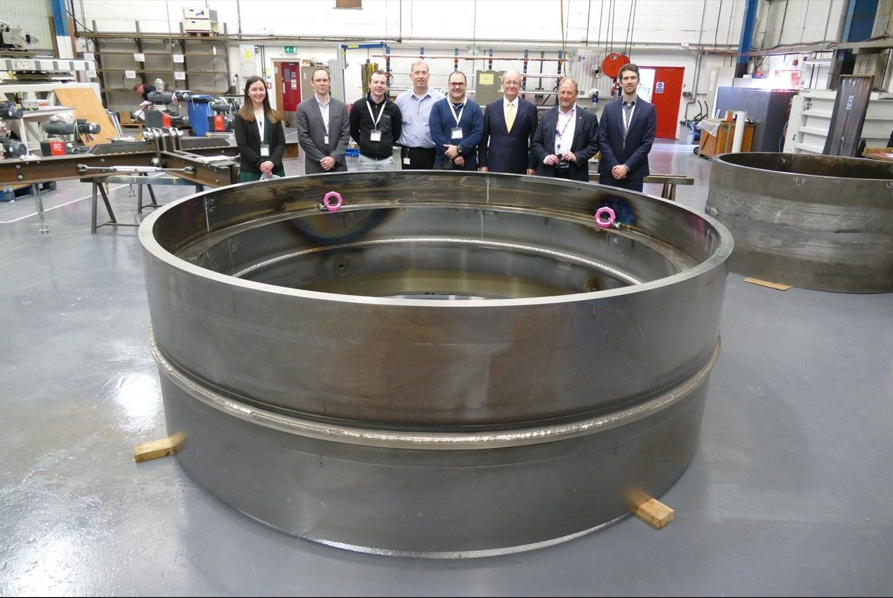
An early proof of concept saw two 200mm thick, three-metre diameter vessel sections welded in a single pass in just 140 minutes with no reportable defects – work that would conventionally have taken months. The pinnacle of the programme came in February 2024, when the first full-sized SMR nuclear vessel demonstrator was completed. Four nuclear-grade welds were finished in under 24 hours, with 100 per cent success and zero defects, against an estimated year of work using conventional techniques.
"The implication of this technology within the nuclear industry is monumental, potentially taking high-cost welding processes out of the equation. Not only does this reduce the need for weld-inspections, but it could dramatically speed up the roll-out of SMR reactors across the UK and beyond."
Dr Michael Blackmore, Senior Development Engineer and Project Lead, Sheffield Forgemasters
Significance & Implications
Sheffield Forgemasters now holds several years of developmental lead over global competitors in the welding of thick-walled assemblies. Because the LEBW weld-join replicates the properties of the parent material, the need for extensive in-process inspections and heat-treatment is substantially reduced, offering significant savings in time and cost. The technology has implications beyond nuclear, extending to any industry requiring thick-walled welded assemblies.
"This is the most critical milestone in our project to industrialise LEBW."
Professor Jesus Talamantes-Silva, Engineering and Technology Director, Sheffield Forgemasters